
Not a one-time project. A continuous operating rhythm — how the company's value creation system gets built, what gets measured and how, and where AI fits into the work.
The value chain is the structure everything else runs on, and it is not one flat layer. Think of the company as an automobile: Capabilities are the subsystems built into it, like steering and braking. Processes are the smaller engineered parts each subsystem is built from. Resources — labor, tools, services, materials — are the individual components each of those parts runs on. None of these pieces do anything on their own. They are engineered to fit together tightly, on purpose, so the whole company can hit the performance standard it is accountable to. That structure is necessary, and it is not the whole system.
The structure gets built the same way, every time — target value first, work required second, resourcing last:
The KPIs (Key Performance Indicators) and jobs-to-be-done tied to each part of the business establish what outcomes must be produced — what success looks like, for whom, at what standard.
With target value defined, map what work has to exist to produce it. This reflects delivery requirements — not current headcount, and not how the org chart happens to be drawn today.
Only once the value chain structure is set does resourcing get decided — which processes run internally, which are outsourced, which are a hybrid. Resourcing follows the value chain. It never shapes it.
A value chain built from a resource map reflects your company's history. A value chain built from target value reflects what it actually takes to deliver. Only the second one can be optimized.
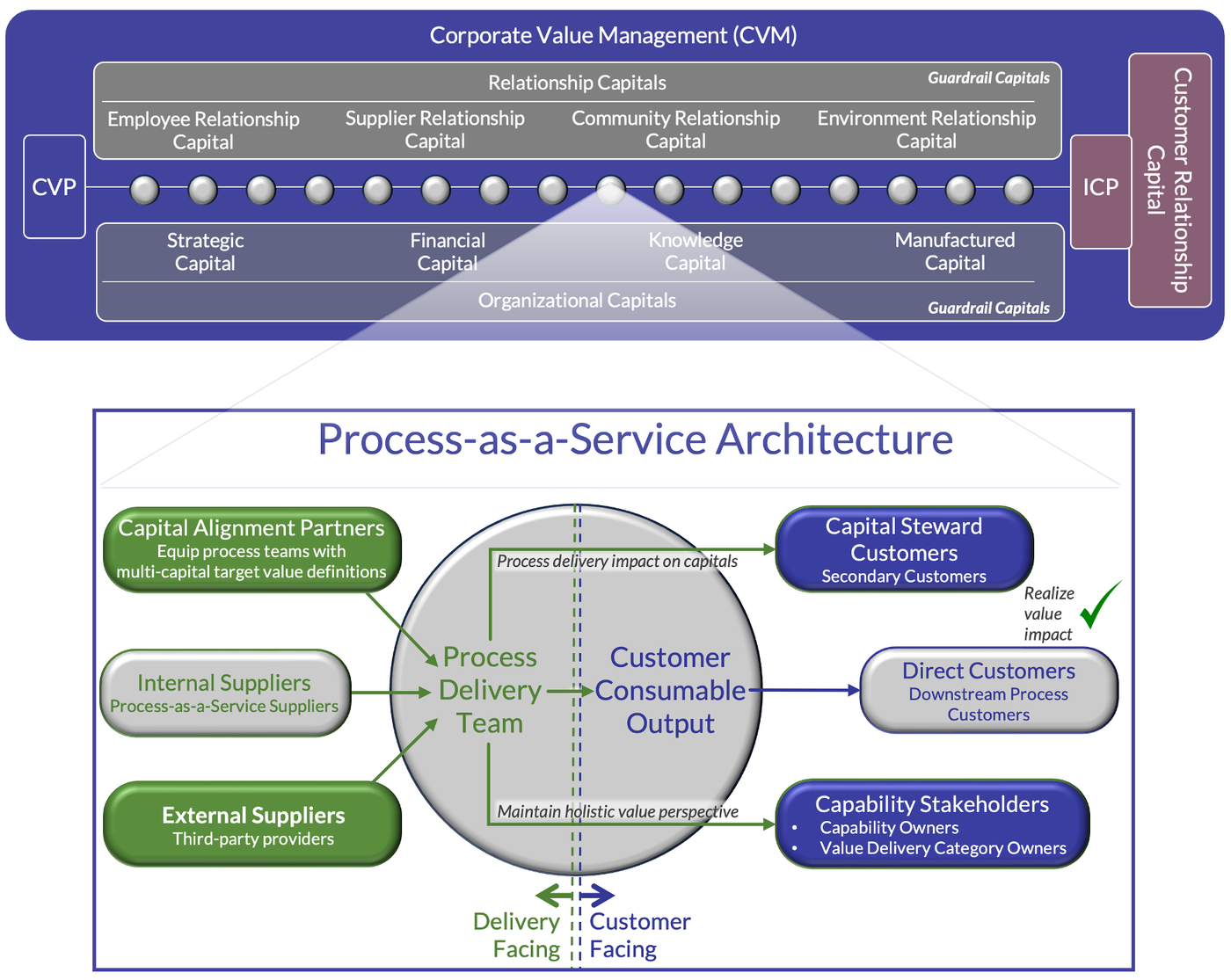
CVP and ICP anchor the value chain at each end, setting target value for the company as a whole and for the customer. Neither one defines target value at any single process in between — that is separate, ongoing work, done by the process owners and suppliers at that link, rationalized against the target set above and kept current as part of the operational cadence. Zoomed in on one link: a delivery team with named customers and suppliers, sitting inside the same nine capitals described above — Relationship and Organizational Capitals as guardrails, Customer Relationship Capital as the primary outcome. This is the literal structure the platform builds and scores — not a metaphor.
The structure and the target value above do not do anything on their own. They define a state; nothing is activated yet. What makes it active is CVM (Corporate Value Management): the operational cadence, not a project — an ongoing rhythm that runs on top of the structure every day, continually asking whether the systems built on it are still optimized for target value, and adjusting when they are not.
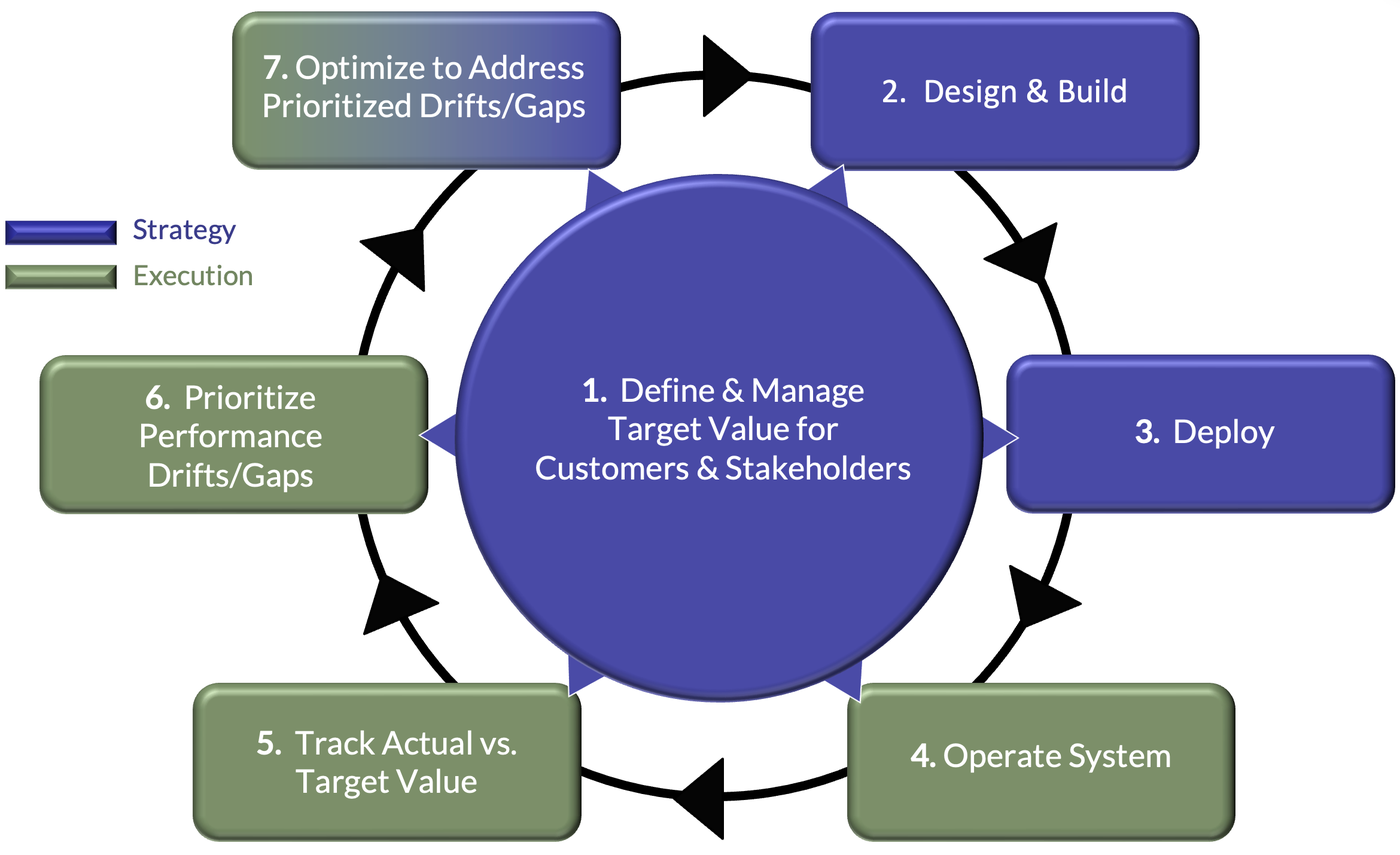
Strategy stages set and adjust target value. Execution stages run the work and surface where actual performance is drifting from it. The cycle never stops — every pass feeds the next.
Every company already knows how to steward one kind of capital well: financial. There is a named owner — the CFO — an agreed definition of health, KPIs, and real governance. Each of the nine capitals is a store of value — something the company holds that is, at any given moment, either being built up or drawn down by the work happening across the value chain. CVM extends the same model that already exists for financial capital, steward, definition, KPIs, governance, to the eight other stores of value that also determine whether a company is actually healthy, not just profitable this quarter.
Every great restaurant runs on one rule: everything happening in the kitchen exists to serve what happens in the dining room. Most companies never learned that rule.
A restaurant's customers judge their experience on four things: the quality of the food, the experience of being there, how long it takes, and what it costs. Those four dimensions, Quality, Experience, Time-to-Value, and Cost, are dining room metrics. They are the only metrics the customer should ever have to think about.
The discipline: every kitchen metric should be traceable to one or more dining room metrics. If a KPI cannot be traced to Quality, Experience, Time-to-Value, or Cost, that raises a real question — why is it being tracked at all? And hitting dining room metrics while the kitchen is quietly failing is not success. It is a delayed crisis.
In CVM, every person who delivers a process-as-a-service is a service delivery team. The processes and disciplines they manage are their kitchen. The value outcomes their downstream customers measure them against are their dining room.
The Value Flow Health Index (VFHI) rolls up every dining room metric, across every capital, across the entire value chain, into a single score. It is not a proxy or an estimate — it is the direct roll-up of how well the company is actually delivering, calculated the same way every time.
See real before-and-after results from three client engagements
The org chart was never built to manage value — for people, or for AI. Assign a person to a department with no defined tie to the value chain, and misalignment is the predictable result: different priorities, redundant work, decisions that look locally right and add up to something worse. Assign an AI agent to that same undefined structure, and the same failure happens. Just faster. A well-scoped agent will still hit its own local target. Its dashboard can be green. The failure is not in the agent — it is that nobody defined how its work connects to the rest of the value chain, so excellence in the part quietly degrades the whole.
A human doing a mediocre job in a silo usually shows visible strain. A locally excellent AI agent in a silo can quietly produce a green dashboard while the company drifts — with no warning until a small problem has become an expensive one.
The same sequence THE METHOD establishes above for people governs how AI agents get assigned: process first, resourcing after. In Insights7, an AI agent is a delivery resource, allocated to a role inside a defined process — the same as a person. It can be Responsible for the work. It is never Accountable for it; that stays with the human Process Owner, Capability Owner, and Capital Steward who own the outcome.
That is a different fix than the one most of the market is proposing. The common answer to AI-driven silos is better shared data — a context layer, so every agent works from the same facts. That is necessary, and Insights7 is not competing with it. But shared facts alone do not tell an agent, or a person, what "right" looks like. Perfect data plumbing can coexist with zero agreement on what success actually is. Insights7 supplies the layer underneath that one: the specification of what each process, capability, and the company itself is actually trying to achieve — so a shared fact means something once it arrives.
And because every AI agent, like every person, is allocated to a specific process, its return is not a single company-wide guess. It rolls up the same way a person's does: against the target value of the process it is actually doing the work in.
The natural assumption is that building all of this out takes months and pulls a company's best people off their real jobs to do it. That is true of most transformation work. It is not true here, and it is worth explaining why before the numbers below make the same claim on their own.
The baseline value chain build takes under four hours, and it does not run on your team's time. Insights7's AI derives the initial context, roles, priorities, terminology, from materials the company already has: the org chart, strategy documents, existing messaging, the website. From there, a short set of validation conversations with the relevant leaders confirms or corrects what the AI inferred, rather than starting each of them from a blank page. The heaviest remaining tailoring work sits on the offering and production side of the value chain, since customer-journey structures are already largely templated in the underlying specification.
The result is not a rough sketch that still needs to be rebuilt from scratch. The first time a company sees its own value chain structure, it is typically 80–90% accurate already. That accuracy is not a guess: the AI is built on patterns from nearly two decades of doing this work by hand, so it already has a strong sense of what a value chain in a company like yours tends to look like, before it has seen a single one of your materials. Validation conversations close the remaining gap; they are not where the real work starts.
The mechanics above are what you are actually paying for. Pricing is tied to cash operating expense, not seats, so it scales the way the rest of this does.